Product Hunt Alternative
Product Hall of Fame
ProductFame helps founders launch products, gain visibility, and earn backlinks while users discover new startups and tools.
ProductFame helps founders launch products, gain visibility, and earn backlinks while users discover new startups and tools.
Overview
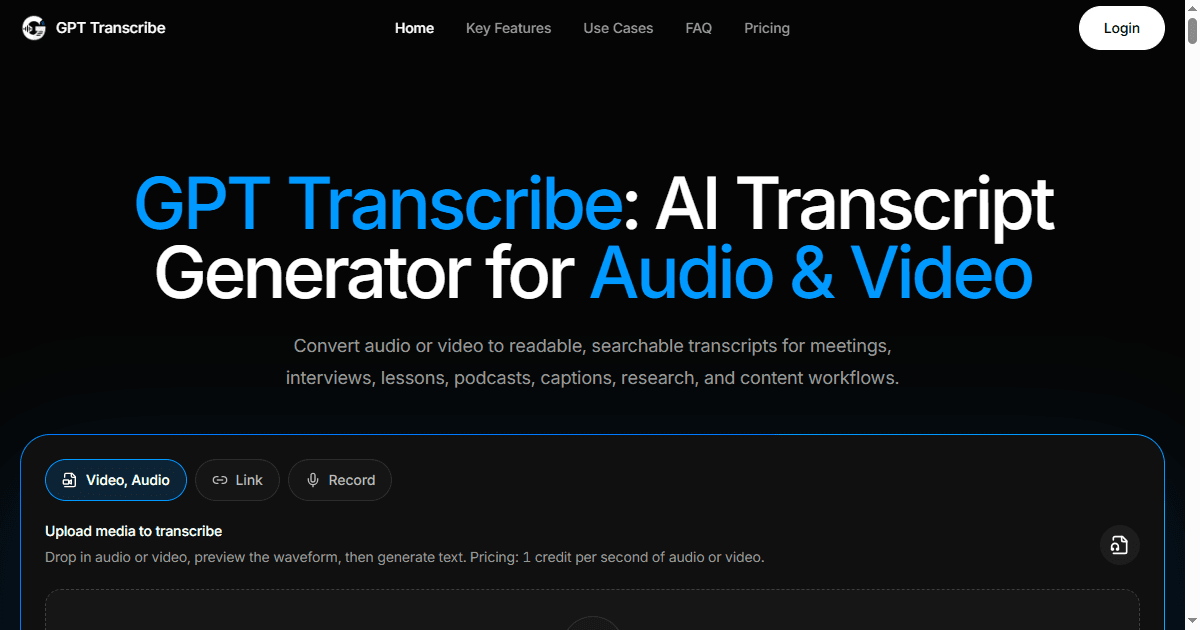
GPT Transcribe is presented as a browser-based transcription workspace for turning recorded speech into reviewable text drafts. This listing treats transcription as one stage in a controlled documentation workflow. It does not assert fixed accuracy, speed, language coverage, price, model version, or usage limits because those details can change and should be checked on the live product page.
Define the transcript brief before upload
A useful brief identifies the source type, intended audience, required output, privacy constraints, speaker-label needs, terminology list, and review owner. Meeting notes, interviews, podcasts, subtitles, and accessibility transcripts have different acceptance criteria. Defining those criteria before processing prevents a readable draft from being mistaken for a verified record.
Prepare source audio and context
Transcription quality depends on the source and the context supplied to reviewers. Keep the original recording, note the language and speaker count, and prepare a list of names, acronyms, product terms, and domain-specific vocabulary. If the recording contains sensitive material, confirm that uploading and processing it is permitted. A transcript should remain linked to its source so uncertain passages can be checked rather than guessed.
Use separate review passes
Review the draft in stages. First check coverage: confirm that no section is missing or duplicated. Next check speaker changes, names, numbers, dates, technical terms, and quotations against the audio. Then review punctuation and paragraph breaks for readability without changing meaning. Finally, apply the destination-specific format, such as timestamps for subtitles, action items for meeting notes, or clear question-and-answer boundaries for interviews.
Track uncertainty instead of hiding it
When a word cannot be confirmed, mark the timestamp and uncertainty rather than replacing it with a confident guess. Keep a short issue list for overlapping speech, background noise, unclear names, and incomplete sentences. This gives the reviewer a bounded verification queue and makes later corrections traceable. Human approval remains necessary before a transcript is treated as a legal, medical, financial, research, or public record.
Potential use cases
Potential uses include meeting-note drafts, interview editing, podcast production, subtitle preparation, searchable research notes, accessibility support, and content repurposing. The final standard should match the destination. An internal discovery draft may tolerate marked uncertainty, while publication, captions, quotations, or formal records require closer comparison with the source.
Review checklist
- Does the transcript cover the complete source without duplicated sections?
- Are speakers, names, numbers, dates, and technical terms verified?
- Are uncertain passages marked with timestamps for review?
- Does punctuation improve readability without changing meaning?
- Have privacy, consent, retention, and disclosure requirements been checked?
- Has a human reviewer approved the final version in its intended context?
Access and current terms
The live GPT Transcribe page is the source to consult for current access, pricing, supported formats, limits, and feature availability. Those facts can change, so this listing avoids fixed quantities and performance promises. Visit https://gpttranscribe.net/ to review the current product information.

Luka Fabry
Product details are supplied by the publisher. Verify current features, availability, and pricing on the official GPT Transcribe website.
Tool Hall of Fame