Disclosure: ProductFame independently reviewed TheAudioStuff's public website, methodology pages, comparison pages, and browser tools. We did not test the audio hardware discussed in this article, and TheAudioStuff had no editorial control over this review.
The best review sites do more than publish opinions. They help a reader move from an open-ended question to a decision they can explain.
TheAudioStuff is unusually good at that transition. It begins as an independent audiophile and hi-fi publication, but its reviews are connected to buying guides, structured head-to-head pages, a gear-finder quiz, and practical audio tools. The result feels less like a stack of articles and more like a compact decision system.
As of September 2, 2026, the site lists 68 scored reviews, 37 head-to-head comparisons across six categories, 11 buying guides, and 16 browser-based audio tools. Those numbers will naturally change; what matters more is how the parts fit together.
Quick verdict
TheAudioStuff is one of the clearest examples we have seen of a specialist publication turning editorial methodology into product design. Its strongest idea is not any single chart or score. It is the continuity between discovery, comparison, technical verification, and the final recommendation.
The scores below are ProductFame's editorial assessment of the website experience. They are not TheAudioStuff's hardware scores, performance measurements, or an independent accessibility certification.
| Evaluation area | ProductFame score | Why it matters |
|---|
| Information architecture | 9.5/10 | Reviews, guides, comparisons, and tools form a coherent decision path. |
| Decision-making utility | 9.4/10 | Score gaps, price context, sound-character notes, and calculators turn browsing into action. |
| Editorial transparency | 9.2/10 | Named writers, a published reference chain, score bands, and loaner disclosures make the method visible. |
| Visual design and legibility | 9.3/10 | Warm neutrals, restrained orange accents, clear hierarchy, and useful data displays support the content. |
| Catalogue breadth | 7.9/10 | The catalogue is selective and weighted toward enthusiast hi-fi rather than every mainstream audio category. |
| Filtering and discovery | 8.8/10 | Category-specific filters and the Help Me Choose quiz are strong; arbitrary cross-category comparison is still absent. |
| Overall | 9.1/10 | A focused publication with an unusually complete decision-making product around it. |
Best for: enthusiasts comparing headphones, DACs, amplifiers, speakers, sources, and accessories; buyers who value long-form listening notes alongside practical calculators; and product designers studying how content can become an interface.
Less ideal for: shoppers who want the broadest possible catalogue of mainstream Bluetooth and ANC travel products, or readers who require standardized laboratory measurements as the primary evidence. TheAudioStuff covers some wireless products and uses measurements when relevant, but its centre of gravity is listening-led audiophile and hi-fi coverage.
What TheAudioStuff actually is
At its core, TheAudioStuff is an independent audio-review publication founded and run by lead reviewer Jakub Charkiewicz. Reviewer and music producer Bastien Beauchamp joined the masthead in 2026. The site covers seven review hubs: headphones, speakers, DACs, headphone amplifiers, speaker amplifiers and preamps, sources, and accessories.
The homepage states the editorial proposition in plain language: long listening, head-to-head comparisons against category references, and no sponsored verdicts. The published methodology says every review receives at least two weeks of daily use and is compared against maintained reference products on the same chain.
Calling it an “audio decision engine” is ProductFame's interpretation, not TheAudioStuff's formal category label. We use the phrase because four connected surfaces repeatedly answer four different buyer questions:
- Reviews: What is this product like, and where does it sit on the site's scoring system?
- Guides: Which products deserve a place on my shortlist?
- Comparisons: What changes when two close candidates are placed side by side?
- Tools: Will this choice work in my actual system, room, files, and listening habits?
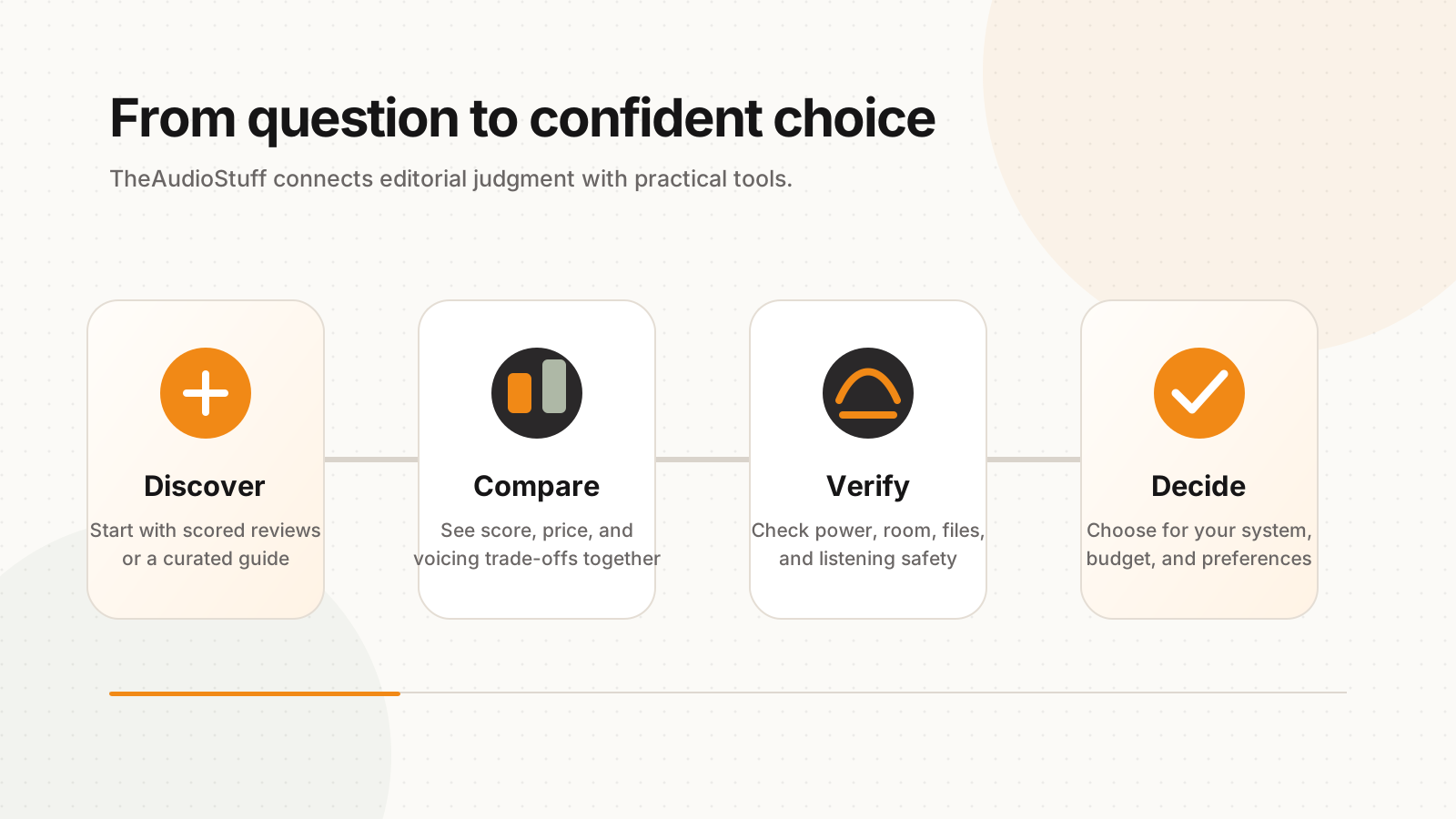
Original ProductFame illustration inspired by TheAudioStuff's warm neutral palette and restrained data-visualization language.
The product-design masterstroke: one continuous decision path
Many editorial sites treat utility pages as SEO satellites. A calculator sits in one corner, reviews in another, and comparison pages are generated without much relationship to either. TheAudioStuff's pieces feel designed to hand a reader from one mode to the next.
A buyer may begin with the Help Me Choose quiz, which asks about category, budget, sound preference, and use case. The resulting shortlist links into scored reviews. Close alternatives may already have a dedicated comparison. A technical uncertainty—amplifier power, listening level, room modes, cable loss, or file provenance—can then be checked with a browser tool.
That flow is important because audio purchases rarely fail for lack of information. They fail because information arrives in incompatible forms: a subjective review in one tab, a specification sheet in another, a forum argument in a third, and an unexplained calculator somewhere else. TheAudioStuff reduces that translation work.
The homepage explains the model before asking for a click
The homepage hero combines a concise editorial promise with a chart of the 14 most recent verdicts. The chart maps scores on a 4-to-10 axis and uses colour to distinguish verdict tiers. A text-table fallback carries the same product, score, and verdict information.
In the page delivered during our review, the chart was native SVG with a reserved 480:214 aspect ratio, accessible labelling, and no visible Chart.js or D3 dependency. That is a sensible, lightweight implementation that reduces the risk of chart-related layout shifts. We did not run a formal Core Web Vitals audit, so we are not claiming a measured CLS score of zero.
The verdict legend also works as navigation into filtered catalogue views. That small choice teaches the scoring model and creates the next action at the same time: readers can see the current distribution—3 Reference, 23 Highly Recommended, 36 Recommended, and 6 Mixed verdicts as of our review date—then open the tier that matches their interest.
Visual restraint earns trust
The interface uses a warm off-white ground, charcoal typography, amber-orange emphasis, soft borders, and occasional muted green. Dense information is placed inside generous spacing rather than hidden behind dramatic decoration. Scores receive visual weight, but trade-offs and methodology stay close enough to prevent the number from becoming the whole story.
The same restraint appears in controls. Search is prominent. Category navigation uses familiar labels. Cards expose price, date, reading time, verdict, and a short summary without forcing the reader through a carousel. The visual system feels specific to audio without leaning on the predictable dark studio, neon waveform, or “luxury black and gold” tropes that dominate the category.
Head-to-head pages make editorial scores useful
The comparison directory listed 37 matchups across six categories when we checked it. The site says pairs are selected when they share a category and tags, sit within 0.5 points, and appear in each other's three most-similar products.
Each page surfaces the numerical gap between two published scores and then explains the practical trade. This does not turn a listening score into a laboratory measurement. It does make the site's own judgments more consistent and easier to interrogate.
Consider three current examples:
- HIFIMAN Arya Organic (9.2) vs. HIFIMAN HE1000se (9.3): the comparison frames the Arya as the lower-priced option with exceptional resolving ability for its tier, while the HE1000se leads on detail retrieval and soundstage. The page recorded a $601 gap on September 2, 2026, but live manufacturer prices can differ.
- Tonewinner AD-1PA+ (9.0) vs. AD-2PRO+ (8.8): both support switchable Class A/Class AB operation. The comparison distinguishes a more powerful standalone amplifier from a less expensive integrated model with source and preamp functions.
- Ekustik Woody Queen (9.0) vs. Ortvik Parametric Tower (8.5): this is not simply absorber versus diffuser. The comparison contrasts a wall-mounted broadband absorber with a freestanding unit that combines diffusion and broadband absorption.
The original draft of this review oversimplified all three comparisons. The correction illustrates why product-review writing needs live source checks: prices change, similar products hide important architectural differences, and one vivid but unsupported phrase can distort a recommendation.
Sixteen tools close the gap between reading and ownership
TheAudioStuff's tools directory is the other major differentiator. Its 16 tools span listening tests and ear training, product discovery, signal and file analysis, amplifier matching, room acoustics, and cable calculations.
The collection includes an ABX blind test, EQ ear-training game, sound-signature quiz, graphic equalizer, safe-volume calculator, gear finder, tone generator, FLAC and hi-res checker, bit-depth calculator, headphone-power calculator, speaker-wattage calculator, SPL-distance calculator, room-mode visualizer, acoustic-panel calculator, speaker-wire gauge calculator, and cable-capacitance calculator.
TheAudioStuff says these tools run in the browser using Web Audio API and client-side computation, require no account or download, and do not upload a user's test files. Its privacy policy clarifies the boundary: files and saved tool inputs stay on the device, while Cloudflare still processes ordinary request information such as IP address, browser type, and requested page to deliver and secure the site.
That distinction is more credible than a blanket “we collect nothing” claim. It also shows mature product thinking: privacy is described in relation to how a feature works, not only in legal boilerplate.
A realistic buying scenario
Take the SIVGA SV021 Pro review. TheAudioStuff currently lists it as the sixth pick in its sub-$200 guide, with a $179 reviewed price, 7.6/10 Recommended verdict, 45-ohm impedance, 106 dB sensitivity, and 289 g weight.
The review praises its natural-wood construction, light weight, breathable velour pads, and energetic bass while noting thin, firm pads, weak passive isolation, and a recessed midrange. SIVGA's own product page describes a wired closed-back dynamic design with a 50 mm composite diaphragm. That manufacturer source is why we have not repeated older claims about rosewood, memory foam, or a six-layer driver.
A buyer can take the verified impedance and sensitivity into the site's headphone-power calculator, then add the real output specification of a laptop, dongle, or amplifier. The headphone specifications alone do not prove that every computer jack is sufficient; the tool encourages the missing system-level check.
For long sessions, the safe-volume calculator estimates SPL and exposure time from sensitivity, impedance, source voltage, and volume position using published WHO/NIOSH guidance. The site presents that output as an estimate rather than a medical or calibrated measurement.
This is the product loop at its best: editorial context creates a shortlist, verified specifications become calculator inputs, and the final decision reflects the user's equipment and habits.
Editorial integrity is visible in the interface
TheAudioStuff publishes five overlapping verdict bands:
| Verdict | Published score band |
|---|
| Reference | 9.0–10.0 |
| Highly Recommended | 8.2–9.4 |
| Recommended | 7.0–8.4 |
| Mixed | 5.5–7.4 |
| Pass | 0.0–6.4 |
The overlaps are deliberate. Price, competition, reliability, ergonomics, and system fit can move a product between adjacent verdicts without pretending the underlying score is infinitely precise. The site says each review is checked against these bands during the build, while a score and verdict separated by two tiers are blocked from publishing.
Five weighted axes create the score: tonality at 30%, technicalities at 25%, then build and ergonomics, system fit, and value at 15% each. More important than the exact weights is their visibility. A reader can disagree with the method because the method is available to inspect.
The current catalogue contains no Pass-tier verdicts. It would be tempting to invent a tidy explanation—that weak products are screened out before testing—but TheAudioStuff does not publish such a rule. The honest conclusion is simply that no Pass verdict is present in the current 68-review catalogue.
The site also says loaner units are identified, affiliate links do not change scores, brands receive no editorial control, and corrections are dated on the affected review. Those are TheAudioStuff's published commitments; ProductFame did not audit private editorial communications.
Accessibility is treated as a product surface
The footer includes a Simplified view control and text-size settings. The control's accessible description says it hides secondary sections such as related links, creating a quieter reading surface. The site's accessibility metadata also states support for keyboard control, high-contrast display, and text reflow.
This is good product design because the alternative reading mode is visible and reversible. It is not tucked away in a policy page.
However, ProductFame did not conduct a complete WCAG audit across every template, state, and viewport. We therefore describe these as visible features and published commitments rather than independently certifying WCAG 2.2 AA compliance or a universal 7:1 contrast ratio.
TheAudioStuff vs. other audio research products
TheAudioStuff should not be praised by understating its competitors. RTINGS has substantial interactive comparison, table, graph, review-list, and custom-rating tools. SoundGuys publishes lab-backed reviews, interactive measurement displays, and a large headphone-versus section. Head-Fi combines an enormous discussion community with articles, gear pages, and classifieds.
| Product dimension | TheAudioStuff | RTINGS | Head-Fi | SoundGuys |
|---|
| Primary format | Scored reviews, guides, comparisons, and browser tools | Standardized lab reviews with data and comparison tools | Community forums plus articles, gear pages, and classifieds | Lab-backed reviews, product pages, and editorial comparisons |
| Direct comparison | 37 auto-selected pages across six categories as of Sep. 2026 | Interactive side-by-side comparison tool | Product and recommendation discussions across community threads | Dedicated headphone head-to-head section |
| Decision tooling | 16 calculators, analyzers, trainers, and a gear-finder quiz | Compare, Table, Graph, Review List, and custom ratings | Forum search, categorized discussion, and community recommendations | Interactive measurements plus category and versus pages |
| Testing emphasis | Weeks of listening on a published reference chain; measurements when relevant | Repeatable standardized lab measurements and controlled comparisons | User experience and methodology vary by contributor | B&K 5128 lab measurements plus hands-on use |
| Access model | Free to read and use today; no account or paywall stated | Full results and analysis require membership; live pricing varies | Reading is broadly public; participation requires registration | Public editorial and product pages |
The meaningful distinction is not “modern versus legacy.” TheAudioStuff integrates listening notes, score-based pairings, and lightweight utilities particularly well. RTINGS and SoundGuys are stronger references when repeatable lab data is the priority, while Head-Fi offers a far broader pool of community experience.
Where the product can improve
1. Let users build their own comparisons
The current pairings are curated automatically from score proximity, category, and tags. That preserves relevance, but a persistent “compare tray” would let a reader carry two or three products from a guide or filtered archive into a custom view—even when the site has not generated that exact pairing.
2. Preserve shortlists across the journey
The Help Me Choose quiz produces a useful ranked shortlist. Saving that list locally and surfacing it on subsequent review and tool pages would make the site feel even more like one product. This could remain account-free by using transparent local storage and a clear reset control.
3. Make the listening/measurement boundary more consistent
The site's listening-first position is clear, and measurements appear when they illuminate a claim. A consistent visual label for “measured,” “manufacturer specification,” and “reviewer observation” would help readers understand the evidence type at a glance.
4. Date volatile commerce data everywhere
The comparison pages use price gaps effectively, but audio pricing moves quickly. Every price delta should show the capture date and source, particularly when manufacturer promotions differ from the review snapshot.
Privacy, advertising, and access: the precise version
TheAudioStuff is free to read, requires no account, and says it uses no first-party analytics, tracking cookies, ad profiling, or consent pop-ups. Its legal notice permits affiliate links and limited display advertising while stating that neither may influence scores or guide rankings.
That means “no sponsored verdicts” should not be misread as “no commercial model.” The sharper product claim is that commercial relationships are separated from editorial scoring and disclosed. We also avoid saying “free forever”: the site is free today and states that it has no paywall, but no responsible review can guarantee a future business model.
Final verdict
TheAudioStuff earns its 9.1/10 ProductFame rating by making specialist expertise easier to use.
The homepage teaches the scoring language. Buying guides create a bounded shortlist. Head-to-head pages explain close calls without hiding price or character. Browser tools connect a general recommendation to a specific system. Methodology, writers, references, and accessibility controls remain visible throughout the experience.
That is the masterclass: content, interface, and editorial policy are not separate layers. They cooperate to help a reader make a decision.
The catalogue is still selective, the listening-led method will not replace a measurement database, and custom comparisons would deepen the workflow. Those limitations are real. They are also signs of a focused product rather than reasons to dilute its identity.
For audiophile buyers, TheAudioStuff is a thoughtful research companion. For product builders, it is an excellent case study in turning trustworthy content into a usable decision system.
Frequently asked questions
Is TheAudioStuff free?
The site is free to read and its 16 browser tools currently require no account, download, or payment. Its legal notice states that there is no paywall. We would not turn that current fact into a promise that pricing can never change.
How does TheAudioStuff score products?
It uses a 0-to-10 score built from five published axes: tonality (30%), technicalities (25%), build and ergonomics (15%), system fit (15%), and value (15%). Scores map to five overlapping verdict bands, and products are compared against published category references.
Are the 1v1 comparisons objective measurements?
No. They compare the numerical difference between TheAudioStuff's own editorial scores and explain the trade-offs on the same listening chain. They make subjective evaluations more consistent and comparable, but they do not turn listening impressions into laboratory measurements.
Do the audio tools upload my files?
TheAudioStuff says its tools use Web Audio API and client-side computation, so files and saved inputs remain on the device. As with any Cloudflare-served site, ordinary request data is still processed for delivery and security.
Does TheAudioStuff cover Bluetooth and ANC headphones?
Yes, but the selection is smaller than on broad consumer-audio publications. The catalogue is weighted toward wired audiophile and hi-fi products.
Has ProductFame certified TheAudioStuff for WCAG compliance or performance?
No. We inspected the public interface and documented visible features such as Simplified view, text sizing, native SVG labelling, and reserved chart geometry. We did not perform a full accessibility conformance audit or a formal Core Web Vitals benchmark.
Facts and live catalogue counts were checked against official first-party pages on September 2, 2026. Prices, counts, and product availability may change.